What people mean by solar aircon
When people ask about solar aircon, they usually mean one of two things. The first is a standard air-conditioner that draws power from a solar power system during the day. The second is a solar-hybrid unit, which is set up to use solar power first and the municipal supply or battery power as backup when needed.
The air-conditioner itself still cools in the normal way. The difference is where the electricity comes from. That matters in Gauteng, where daytime sun can cover a good part of the cooling load in summer, but load-shedding, late clouds and high evening use can still catch people out.
How the system works in plain language
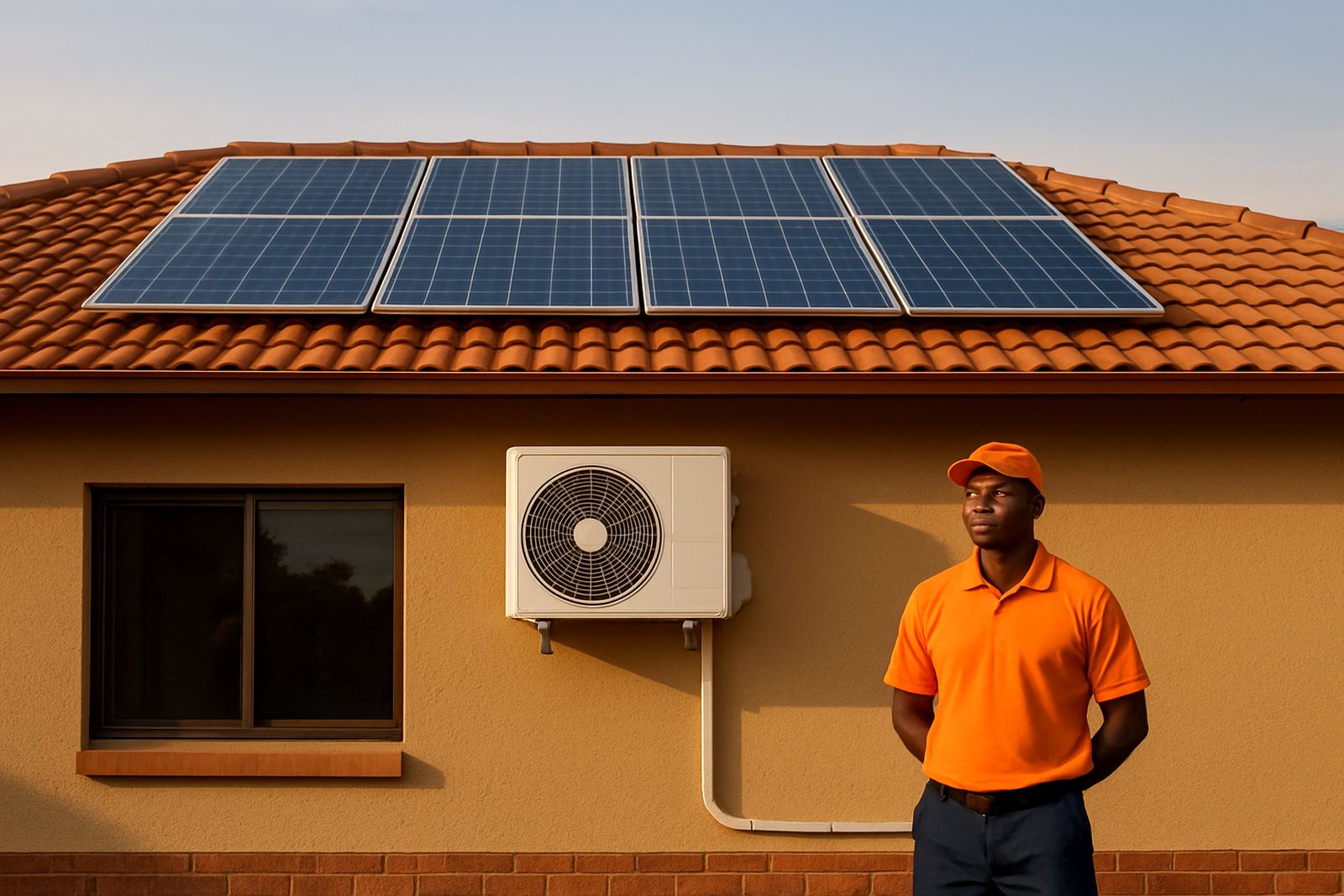
A solar aircon setup usually includes the air-conditioner, solar panels, an inverter and, in many homes, batteries. The panels make DC power from the sun. The inverter changes that power into AC power the aircon can use. If batteries are included, they store extra power for later use. If not, the system generally runs best during sunny hours.
For a house in Randburg or Midrand, that can mean cooling a main bedroom, lounge or small office during the day with far less pressure on the monthly electricity bill. In an office, the benefit is often more noticeable in rooms that run for long hours, like reception, boardrooms and open-plan work areas.
- Panels supply power while the sun is up
- Inverter matches the solar supply to the aircon load
- Batteries help after sunset or during outages
- Backup from the grid keeps things running when solar is low
Solar-hybrid versus fully solar: where each makes sense
A fully solar setup aims to run the cooling system mostly from solar and stored energy. That can work, but it needs more panels, more battery capacity and careful sizing. A solar-hybrid setup is usually easier to live with because it can switch between solar, battery and grid power without forcing you to overspend on hardware.
For most homes in Johannesburg North, Sandton and the East Rand, hybrid is the practical choice. It gives decent daytime savings and keeps the room cool when the weather changes. Fully solar makes more sense where there is strong roof space, predictable day use and a client wants as little grid use as possible, even if the upfront cost is higher.
- Hybrid suits mixed use and ordinary household budgets
- Fully solar suits sites with strong sun exposure and bigger budgets
- Small systems work best for one or two rooms
- Larger properties need proper load checks before anything is ordered
Who gets the most value from solar aircon
Solar aircon is not only for large homes. It often suits people who use the same rooms during the day and want to reduce the spike in electricity use. Think home offices, upstairs bedrooms, small clinics, consulting rooms and retail spaces with steady trading hours.
It also helps on properties where the owner already has solar panels for the rest of the house and wants cooling to share that supply. In coastal humidity this is useful too, but in Johannesburg the bigger driver is often hot afternoons, west-facing windows and the need to keep working when the power is unstable.
A good local example is a two-storey home in Bryanston with a study, main bedroom and family room that heat up after lunch. A properly sized hybrid aircon plan can cool those rooms during peak sunlight, then switch to backup later, instead of pulling full load from the grid every evening.
What to check before you buy or retrofit
Before you choose solar aircon, check the basics. Roof space, panel direction, shade from nearby trees, inverter capacity and battery size all affect the final result. If the property has older wiring or frequent tripping, that must be fixed before the installation goes ahead.
On commercial sites, a site survey is worth the time. Offices in Sandton, Randburg and Midrand often have different cooling patterns from homes, and a system that looks fine on paper can still struggle if the electrical supply is uneven or the units are too far from the solar gear.
- Measure the rooms that need cooling
- Check how many hours the units run each day
- Confirm available roof area and shading
- Match inverter and battery size to actual usage
- Ask about municipal rules and any building approvals if the work affects the structure
Running costs, comfort and maintenance
Solar does not make an air-conditioner free to run, but it can lower the cost of cooling during the day and soften the impact of high tariffs. The saving depends on how much sun you get, how long the aircon runs and whether the system is sized correctly for the site. A small under-sized setup can end up disappointing, while an over-sized one wastes money.
Maintenance is still important. Filters need cleaning, drain lines must stay clear and the electrical side should be checked regularly. In Johannesburg North and the wider Gauteng area, dust and summer storm season can affect performance, so a service plan is often better than waiting for the unit to start making noise or dripping water.
For supply-and-fit jobs, the aim is not just to hang a unit and leave. It is to make sure the system cools properly, starts when it should, and keeps working through load-shedding without constant manual switching.
A practical way to decide if solar aircon suits you
If you mainly need one room cooled for a few hours a day, solar-hybrid aircon is often a smart starting point. If you want all-day cooling for several rooms, the electrical design needs more care and the budget needs to be realistic from the start. That is especially true for offices and larger homes where comfort, quiet operation and uptime matter.
The safest approach is to start with a proper load check and a clear idea of what must stay cool. From there, the right mix of solar panels, inverter, batteries and aircon units can be matched to the property, not guessed at. That saves money and avoids the common mistake of buying gear that looks good but does not suit the actual use.
At Airconditioning Superstore, we handle supply-and-fit for homes and offices across Johannesburg North, Sandton, Randburg, Midrand, the East Rand and the West Rand, so the system can be planned around local conditions from the start.