Comfort that suits overnight guests and busy check-in times
Guest houses work differently from homes. Rooms may sit empty for part of the week, then fill quickly on weekends, school holidays or during events in Sandton, Rosebank and Midrand. The aircon has to cool fast, stay quiet through the night, and still make sense on the monthly electricity bill. For many owners, that means choosing the right size unit for each bedroom rather than using one oversized system for the whole property.
In Johannesburg North and surrounding areas, we usually see a mix of single rooms, family rooms, breakfast areas, reception spaces and sometimes a small office. Each area needs a different approach. Bedrooms often suit wall-mounted split units with inverter control. Shared lounges and dining rooms may need larger capacity units or more than one unit placed to cover the room properly. Where guests are sensitive to noise, the indoor fan speed and compressor start-up matter just as much as cooling capacity.
Good planning also helps with guest comfort during load-shedding and hot summer spells. A properly selected inverter unit can reduce the hard start that older fixed-speed machines give, and that makes a real difference in smaller rooms where people are trying to sleep. It also helps if the property has enough electrical capacity for the number of rooms running at once, otherwise the system can trip when too many units start together.
Typical aircon setup for rooms, lounges and reception
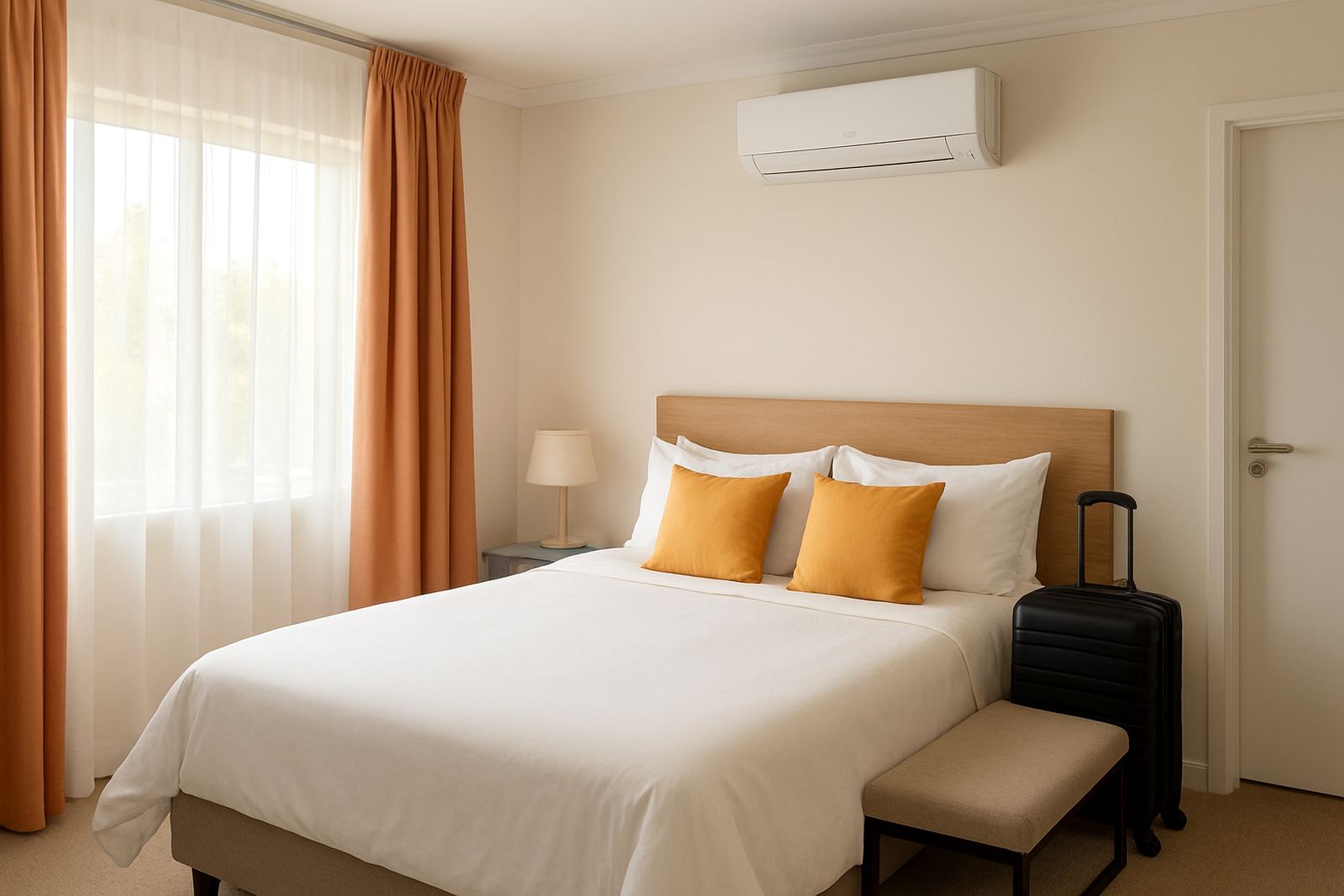
Most guest house projects use a practical mix of equipment rather than one standard model everywhere. We look at room size, ceiling height, sun direction, window area, insulation and how long the room is usually occupied. In a normal setup, bedrooms get individual wall-mounted split units, while the reception and breakfast area may use slightly larger units or separate zones.
- Bedrooms: compact wall-mounted split units, often inverter type for lower running costs and quieter operation
- Family rooms: higher capacity split units, sometimes with better air throw for larger floor space
- Reception and lounge areas: medium capacity units placed to avoid direct cold air on guests
- Dining or breakfast rooms: units sized for short peak use and quicker pull-down time
- Staff or admin spaces: smaller units where the room is occupied for shorter periods
Where the guest house has outside wall restrictions or difficult pipe routes, we plan the installation carefully so the line set, drainage and outdoor unit positions stay neat and serviceable. In some properties, especially older homes converted into guest accommodation, the best solution is not the cheapest one on day one. It is the one that fits the building without causing repeated repairs, water leaks or rattling fittings later on.
Layout advice that saves power and complaints
Aircon layout matters more than many owners expect. A bedroom unit should not blow directly onto the bed if the room is small. In a double room with two single beds or one queen bed, we position the indoor unit so the airflow moves across the room, not into a guest's face. In long rooms, a single unit may leave the far end warm, so it can be better to split the load between two smaller units if the space is unusual.
Outdoor unit placement also needs thought. Guest houses often have limited yard space, boundary walls and neighbours close by. The condenser should sit where it gets enough air movement, where service access is possible, and where the noise will not disturb another room or a neighbouring property. In coastal humidity this is even more important, but in Gauteng dust, lint and leaf build-up can also shorten performance if the unit sits in a poor spot.
- Keep indoor units away from curtains that block airflow
- Do not place outdoor units in a closed corner with no ventilation
- Allow for drainage so condensate does not stain walls or walkways
- Check breaker size and cable routes before the install starts
- Use room-by-room control so empty rooms are not cooling unnecessarily
For properties with frequent guest turnover, easy control is important. Simple remotes with timer functions are usually more practical than complicated controls. Housekeeping teams need to understand the settings quickly, and the system should be easy to reset after cleaning or after a power interruption.
Common mistakes in guest house cooling projects
One common mistake is installing a unit that is too small because it looked cheaper on the quote. A small room with a large west-facing window can heat up fast, especially in summer afternoons. If the unit is undersized it will run hard for long periods, use more power and still leave the room uncomfortable. Another mistake is fitting one unit in a room that really needs better air movement or better sun control.
Another issue is ignoring service access. Guest houses need aircons that can be cleaned and serviced without moving furniture around every time. If a filter is hard to reach, it tends to get skipped and then the room smells stale or the unit starts dripping. Dirty filters can also push dust into the room, which guests notice quickly.
We also see problems when owners do not plan for electrical loading. A property with several rooms running aircons, fridges, geysers and kettles at the same time may need load management. If the board is already near capacity, a proper survey should come before any installation. It is better to check this early than to have tripping in peak check-in hours or when the kitchen is preparing breakfast.
Budget ranges for guest house aircons in Rand
Budgets depend on the number of rooms, the type of unit, pipe length and how much electrical work is needed. As a rough guide in Gauteng, a single bedroom supply-and-fit project may start from about R9,500 to R15,000 for a standard split unit, with inverter models usually sitting higher. Larger rooms, longer pipe runs or difficult mounting conditions can move the price up. If the project needs a special bracket, extra cabling or a longer drainage route, that also affects the final figure.
For a small guest house with several rooms, owners often look at total project cost rather than just one unit. A 4 room property can end up in the R40,000 to R85,000 range depending on capacity and site conditions. Bigger hospitality sites, or buildings where multiple common areas need cooling, may go higher. We always recommend getting the room list and measurements first so the quote matches the building instead of guessing from a photo.
Service and maintenance also matter in the budget. Regular cleaning and inspection cost far less than replacing a failed compressor or dealing with water damage from blocked drains. For many guest houses, a planned service interval before summer is one of the smartest spends of the year.
Why guest house owners call us for supply and fit
We work across Johannesburg North, Sandton, Randburg, Midrand, the East Rand and the West Rand, so we understand the kind of buildings guest houses use here. Some are converted homes with older wiring. Others are newer hospitality units with tighter rules about noise, appearance and wall penetrations. Our team can handle supply, fitment, replacements, relocations, servicing and repairs, which keeps the process simple for owners and managers.
Thabo Mokoena leads the business from our Johannesburg North base, with support from Naledi Khumalo on sales, Pieter van Rensburg on installations, Ayesha Patel on service coordination, Sibusiso Dlamini on technical support and Lerato Molefe on heat pump work. That means guest house owners deal with people who understand both the product and the day to day pressure of keeping rooms ready for arrivals. If a room is out of order, it affects occupancy straight away, so response time matters.
Whether you need one replacement unit in a bedroom or a full project for a guest house with shared spaces, we look at comfort, running cost and service access together. The aim is not just cold air, it is a system that keeps guests sleeping well and keeps the property easier to manage.
- Bedrooms and family rooms sized to the actual room volume
- Shared areas planned for occupancy peaks, not just average use
- Repairs and servicing handled with practical access in mind
- Clear recommendations for properties that run on tight electricity budgets